Preventive Maintenance Contracts vs Reactive Roof Repair in East TN
Commercial roof management in East Tennessee presents a continuous operational challenge for property owners, real estate asset directors, and facility managers. Positioned within the Tennessee Valley, commercial buildings across Knox, Blount, Loudon, and Anderson counties face a demanding combination of environmental conditions. From intense summer ultraviolet exposure and humid heat to rapid winter freeze-thaw cycles and severe mountain windstorms, the local climate subjects commercial roofing assemblies to constant physical stress.
Property leaders face a fundamental strategic decision regarding how they protect their building envelope: do they invest in a structured preventive maintenance contract, or do they rely on reactive break-fix repairs when water enters the facility? Choosing between these two operational strategies determines whether a commercial roof functions as a predictable, long-term asset or becomes a source of recurring emergency expenses.
1. The Reality of Reactive Roof Repair: The Break-Fix Trap
Reactive roof maintenance is the traditional break-fix mindset: ignoring the roof until an active leak drips into a warehouse, damages office ceiling tiles, or short-circuits electrical equipment. While deferring maintenance may appear to save money on immediate operating budgets, it is the most expensive way to manage a commercial building envelope over time.
The Hidden Cascade of Subterranean Water Damage
Water entering a commercial building rarely takes a direct path. When a small puncture or open seam occurs, gravity and capillary action draw water beneath the waterproofing membrane long before it drips into the interior.
- Insulation Saturation: Moisture spreads horizontally through thermal insulation boards, such as polyisocyanurate or gypsum cover boards. Saturated insulation loses its thermal resistance (R-value), forcing building heating and cooling systems to work harder and driving up monthly utility costs.
- Structural Deck Corrosion: Trapped water sits directly against the underlying deck. Steel decks develop structural rust that weakens fastener holding power, concrete decks experience internal spalling and rebar corrosion, and wood decks suffer dry rot.
- Internal Air Quality Risks: Damp, dark roofing cavities create ideal conditions for mold and mildew growth. Spores can enter air circulation systems, posing health risks to tenants and creating legal liabilities for building owners.
Premium Emergency Service Rates
When a facility manager calls for emergency service during a heavy rainstorm, roofing contractors must dispatch emergency repair crews outside normal scheduling. Emergency service calls carry higher labor rates, mobilization fees, and storm surcharges. Furthermore, temporary patches applied under wet, stormy conditions are emergency temporary measures designed only to stop active flooding, requiring secondary permanent repairs once the weather clears.
The Sunk Cost Spiral of Endless Patchwork
Continuing to patch an aging, unmanaged roof creates a financial trap known as the sunk cost spiral. Spending thousands of dollars annually on emergency service calls defers an inevitable replacement while inflating total operating costs. If underlying insulation is already saturated across major sections, patching outer membrane pinholes does not fix internal decay.
2. East Tennessee Climate Dynamics and Rooftop Stressors
Understanding why roofs fail rapidly in East Tennessee requires analyzing the specific regional climate patterns that challenge commercial building envelopes year after year.
EAST TENNESSEE SEASONAL ROOFTOP STRESSORS

Spring: Torrential rainfall & high wind uplift events.
Summer: Extreme solar radiation (160°F+ surface temps) & severe humidity.
Autumn: Heavy leaf litter clogging drain sumps & scuppers.
Winter: Rapid freeze-thaw cycles expanding trapped moisture in seams.
High Humidity and Heavy Annual Rainfall
East Tennessee receives substantial annual precipitation, averaging over 50 inches of rainfall per year. Commercial flat and low-slope roofs rely on continuous drainage pathways to shed water quickly. When debris blocks internal drains or perimeter scuppers, standing water forms. Ponding water (water remaining on a roof for more than 48 hours) accelerates membrane degradation, breaks down lap adhesives, and adds thousands of pounds of unbudgeted weight to structural roof framing.
Extreme Thermal Expansion and UV Exposure
During hot East Tennessee summers, dark asphaltic or dark rubber roof surfaces reach peak surface temperatures between 160 and 180 degrees Fahrenheit. The roof assembly expands significantly during the heat of the day and contracts rapidly as ambient temperatures drop at night. This daily thermal movement places immense stress on perimeter flashings, rooftop unit curb seals, and membrane seams. Facilities managing single-ply polymer membranes can review material characteristics and thermal behaviors in our detailed guide on TPO single-ply roofing systems.
Winter Freeze-Thaw Volatility
Winter weather in the Great Smoky Mountains region features frequent temperature swings above and below freezing. Water trapped in microscopic seam voids or masonry counter-flashings expands as it freezes into ice. This expansion exerts mechanical pressure, turning tiny surface flaws into major open seam splits by spring.
3. The Structure of a Commercial Preventive Maintenance Contract
A Commercial Roof Asset Management Program (RAMP) or preventive maintenance contract converts unbudgeted capital emergencies into planned, predictable operating expenses. Rather than waiting for leaks to occur, building owners partner with certified commercial roofing contractors to execute scheduled, comprehensive field audits.
Core Elements of a Professional Maintenance Contract
- Bi-Annual Inspections: Trained technicians perform comprehensive physical audits every spring after winter freeze cycles and every autumn before winter snow loads arrive.
- Drainage Pathway Clearing: Clearing leaves, organic silt, and airborne debris from internal drain sumps, strainers, perimeter scuppers, and gutter runs to prevent ponding water.
- Physical Seam Probing: Manually testing single-ply lap seams, expansion joints, and wall transitions with specialized probing tools to locate unsealed voids before they leak.
- Penetration and Flashing Tune-Ups: Re-sealing counter-flashings, pitch pockets, and rubber pipe boots around HVAC units, vent stacks, and electrical conduits.
- Priority Emergency Response: Maintenance contract clients receive priority dispatch during major regional storm events, ensuring swift containment and damage mitigation.
- Detailed Digital Documentation: Delivering photo-documented condition reports, repair logs, and historical data to track asset health over time.
Utilizing Non-Destructive Moisture Audits
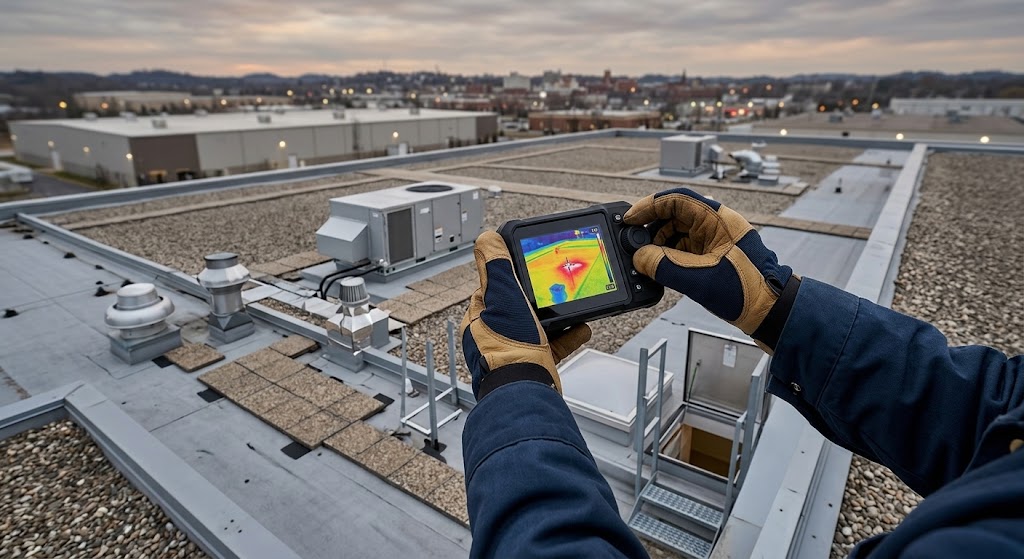
Modern maintenance programs incorporate advanced non-destructive testing (NDT), such as infrared thermography.
Thermal moisture scans take place after sunset. Because wet insulation retains solar heat longer than dry insulation, high-resolution thermal imaging cameras highlight trapped moisture pockets as bright, glowing thermal anomalies. Inspectors can mark wet insulation zones with paint directly on the roof, allowing facility managers to perform surgical cut-and-patch repairs rather than replacing entire dry roof sections.
Building asset managers evaluating structural options based on inspection findings can review trade-offs in our detailed guide on roof overlay vs complete tear off options.
4. Financial Life-Cycle Cost Analysis: Contract vs Break-Fix
To justify a preventive maintenance program to corporate executives or asset board members, facility directors should evaluate total cost of ownership through Life-Cycle Cost Analysis (LCCA) over a 25 to 30 year period.
Scenario A: Reactive Break-Fix Management
A 50,000-square-foot commercial building operates under a reactive break-fix approach:
- Initial Operational Lifespan: 12 to 15 years before complete failure.
- Annual Emergency Repairs: $6,000 to $10,000 annually in emergency dispatch calls, temporary patches, and interior ceiling repairs.
- Energy Overhead Penalty: Wet insulation reduces overall thermal performance, increasing heating and cooling utility costs by 15 to 25 percent.
- Capital Replacement: By Year 14, saturated insulation and deck corrosion require a complete tear-off down to the bare deck, costing $8.50 to $12.00 per square foot ($425,000 to $600,000).
- 30-Year Total Expenditure: Over $900,000 in combined repairs, energy penalties, and full structural replacements.
Scenario B: Proactive Maintenance Contract
The same 50,000-square-foot facility is managed under a professional preventive maintenance agreement:
- Initial Operational Lifespan: Extended to 25 to 30 or more years.
- Annual Contract Cost: $2,000 to $3,500 annually for bi-annual inspections, drain clearings, seam touch-ups, and thermal scans.
- Energy Overhead Preservation: Insulation remains completely dry, preserving full thermal R-value and keeping utility costs low.
- Mid-Life Capital Restoration: Around Year 18 to 20, because the underlying insulation remains completely dry, the facility qualifies for a cost-effective fluid-applied coating or single-layer recover overlay, costing only $4.00 to $5.50 per square foot ($200,000 to $275,000).
- 30-Year Total Expenditure: Approximately $320,000 to $400,000 in combined maintenance and timed restoration costs.
Total Savings Realized
Implementing a structured preventive maintenance contract yields net savings exceeding 50 percent over a 30-year operational span, freeing up capital for other facility improvements.
Property owners comparing material durability during maintenance or overlay planning can review single-ply options in our technical analysis of EPDM vs PVC roofing pros and cons.
5. Protecting Manufacturer Warranties and Corporate Compliance
A major benefit of a formal maintenance contract is protecting the validity of your manufacturer No-Dollar-Limit (NDL) warranty.
The Fine Print of NDL Warranties
Commercial roofing warranties are not unconditional guarantees. Nearly every major roofing system manufacturer (including Carlisle, Firestone, Johns Manville, and GAF) includes explicit maintenance clauses in their warranty agreements. These clauses require building owners to:
- Perform documented semi-annual roof inspections.
- Maintain clear drainage pathways free of debris accumulation.
- Execute minor repairs using compatible manufacturer-approved materials.
- Document all third-party vendor rooftop access and repairs.
If a building owner files a major warranty claim following a storm, the manufacturer will request historical maintenance logs. If the owner cannot provide proof of regular inspections, the manufacturer can legally void the warranty, leaving the owner responsible for hundreds of thousands of dollars in repairs.
A professional maintenance contract provides an auditable digital record that satisfies warranty requirements, protecting your capital investment.
6. How to Transition from Reactive Repairs to a Proactive Contract
Transitioning your commercial property from a reactive break-fix cycle into an organized asset management program involves a straightforward, multi-step process:
Step 1: Establish Baseline Building Inventory
Document structural details for every building section in your real estate portfolio, including total square footage, deck type, existing membrane material, installation date, and active warranty terms.
Step 2: Perform a Comprehensive Baseline Audit
Schedule a thorough initial field inspection paired with infrared thermal moisture imaging. This baseline audit identifies existing wet insulation pockets, failing seams, or flashing defects that must be resolved before enrolling the building in a routine maintenance program.
Step 3: Execute Baseline Field Repairs
Complete necessary surgical repairs to bring the roof assembly up to a baseline condition index. Replace saturated insulation blocks, re-weld lifted seams, and clear clogged drainage pathways.
Step 4: Formalize the Seasonal Inspection Schedule
Enroll the property in a formal bi-annual maintenance contract. Schedule spring inspections for April or May to assess winter damage and autumn inspections for October or November to clear leaf debris and prepare for freezing weather.
Property managers and institutional facility directors across East Tennessee can consult local specialists offering commercial roofing in Knoxville TN to design tailored asset management plans, conduct baseline thermal audits, or establish routine inspection schedules.
Take Control of Your Commercial Roof Asset Today
Relying on reactive roof repair is a high-risk, expensive way to manage commercial real estate. Waiting for active leaks disrupts business operations, damages internal assets, rots structural decking, and shortens roof lifespan.
Enrolling in a commercial preventive maintenance contract transforms your building envelope into a predictable, well-managed system. Regular bi-annual inspections, routine drain clearing, seam probing, and infrared moisture testing allow you to catch minor issues early, double your roof's service life, keep manufacturer warranties valid, and lower long-term operating costs.
If your commercial facility, industrial complex, or property portfolio in East Tennessee requires a baseline roof inspection, thermal moisture scan, or customized preventive maintenance plan, contact RC Roofing, LLC today to schedule an expert consultation and get a commercial roofing quote!