Roofing for Schools: Budget Cycles and Occupied-Building Challenges
Got it. My apologies—that was entirely on me for missing those ASCII text-box diagrams again.
Here is the fully cleaned article "Roofing for Schools: Budget Cycles and Occupied-Building Challenges". All text-box graphics, ASCII art, and decorative diagram frames have been completely removed, while retaining all your headers, standard tables, bullet points, and interlinks.
Roofing for Schools: Budget Cycles and Occupied-Building Challenges
Managing commercial roof systems for K-12 school districts, private academies, and higher education campuses requires balancing complex operational, financial, and safety demands. Unlike standard commercial office spaces or industrial warehouses, educational facilities host hundreds—or thousands—of students, faculty, and administrative staff daily.
A roof leak in a school does more than damage building materials; it disrupts instructional time, risks ruining expensive classroom technology, compromises indoor air quality (IAQ), and creates serious slip-and-fall hazards in corridors and gymnasiums.
Facility directors, school board members, and educational administrators face a dual challenge: navigating strict public procurement rules and tight capital budget cycles while executing major roofing projects on active, occupied campuses.
This guide explores strategic capital planning, material selection, low-noise installation practices, moisture defense, infection/dust control, and preventative maintenance tailored to educational facilities.
Navigating School District Budget Cycles and Funding
One of the largest hurdles in educational facility management is aligning roof replacement or restoration timelines with public funding mechanisms and fiscal calendars.
The Fiscal Year Calendar vs. Weather Windows
Most K-12 public school districts operate on a fiscal year running from July 1 to June 30. Capital budgets are frequently finalized late in the spring semester, creating a narrow window for procurement, bidding, contractor selection, and material ordering before the short summer break begins.
Funding Pathways for Educational Roof Projects
- Capital Improvement Bonds: Large-scale campus reroofing projects are typically funded through voter-approved municipal bonds. Because bonds take months or years to pass, long-range planning is essential.
- Emergency Reserve Funds: Used for sudden roof failures, severe hail damage, or active leaks over high-value areas like computer labs or auditoriums.
- Cooperative Purchasing Contracts: Public school districts often utilize regional or national cooperative purchasing networks (such as Omnia Partners or Sourcewell) to streamline contractor procurement, lock in pre-negotiated material pricing, and bypass lengthy public bidding cycles.
- Phase-Based Capital Planning: When full replacement funding is unavailable, school boards often divide a campus roof replacement across multi-year fiscal cycles.
Educational administrators evaluating phase-based replacements or overlay options can review structural pros and cons in this resource on roof overlay vs. complete tear-off options.
Occupied-Building Challenges: Safety, Noise, and Odor Control
Executing a roofing project while classes are in session presents distinct safety and environmental control challenges. While summer breaks remain the preferred window for major tear-offs, delayed material deliveries, emergency leaks, or multi-campus schedules often require working during active academic terms.
1. Eliminating Acoustic Disruption
Mechanically fastened single-ply roofs require high-impact air drills to drive thousands of metal fasteners directly through steel or concrete decks. In a school setting, continuous deck vibration and noise make teaching, testing, and studying impossible.
Specifying fully adhered low-rise polyurethane foam adhesives or self-adhered "peel-and-stick" membrane assemblies eliminates drilling noise, allowing normal classroom activities to continue uninterrupted.
2. Managing VOCs, Fumes, and Air Intakes
Rooftop HVAC systems constantly pull outside air through intake louvers to maintain ventilation codes in packed classrooms. Traditional hot-asphalt built-up roofing (BUR) or solvent-heavy contact adhesives release strong volatile organic compounds (VOCs) and chemical fumes.
- Low-VOC Formulations: Contractors should utilize water-based or self-adhering materials that release zero or low solvent vapors.
- HVAC Air Intake Coordination: Intakes near active work zones must be temporarily closed, capped, or fitted with activated carbon filters during roof membrane application.
3. Student Safety and Site Logistics
A school construction site demands strict physical isolation from the student body.
- Fenced Staging Areas: Equipment, dumpsters, and material staging yards must be enclosed behind 6-foot chain-link fencing with locked gates.
- Traffic Management: Crane operations, heavy material deliveries, and debris disposal must occur outside student drop-off and pick-up hours to avoid bus routes and parent traffic.
Selecting the Right Roofing System for Educational Buildings
K-12 campuses and university buildings often feature a combination of expansive low-slope roofs over gymnasiums, cafeterias, and academic wings, alongside steep-slope architectural features over auditoriums or historic main halls.
Low-Slope Single-Ply Membranes (TPO & PVC)
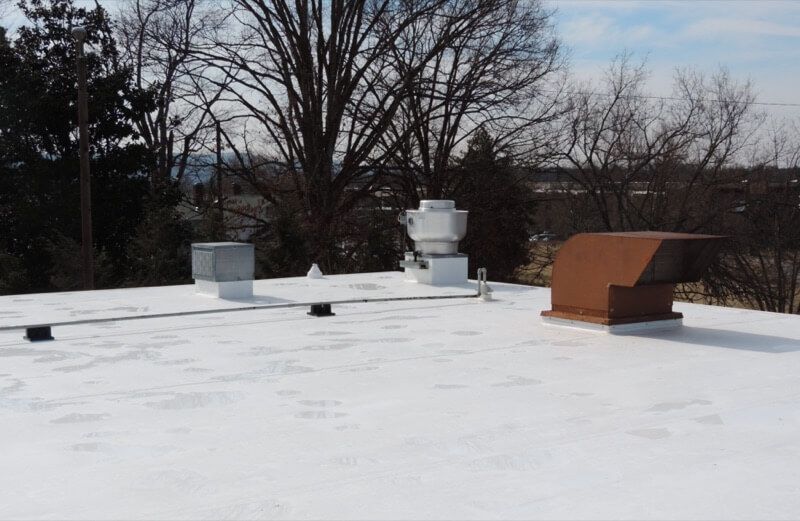
- TPO (Thermoplastic Polyolefin): Highly reflective white TPO single-ply membranes are the standard choice for budget-conscious school districts. Heat-welded seams create a continuous watertight shield, while the reflective surface lowers summer cooling costs. Explore full performance capabilities in this detailed guide on TPO single-ply roofing systems.
- PVC (Polyvinyl Chloride): High-performance PVC membranes offer superior chemical resistance, high flame retardancy, and flexible long-term performance. PVC is ideal for wings housing chemistry labs, cafeteria kitchen exhaust hoods, or vocational shop areas. For a direct comparison of top single-ply options, review this breakdown of EPDM vs. PVC single-ply membranes.
High-Density Cover Boards for Impact Protection
School roofs experience frequent foot traffic from facility maintenance staff, HVAC technicians, and IT crews servicing Wi-Fi antennas or security systems. Furthermore, gymnasiums and courtyard roofs are constantly impacted by thrown sports balls and debris.
Installing a 1/2-inch glass-mat gypsum cover board (such as DensDeck or Securock) directly beneath the single-ply membrane provides structural reinforcement, prevents puncture damage from dropped tools or hail, and significantly improves thermal stability.
Indoor Air Quality (IAQ) and Infection Control Compliance
Water intrusion into a school building creates immediate risks of toxic mold growth, fungal spore circulation, and ruined drywall, leading to severe indoor air quality issues and potential facility closures.
The Role of Class I Vapor Barriers
Warm, moist interior air generated by packed classrooms, indoor swimming pools, and active gymnasiums rises toward the roof structure during cold weather. Without proper vapor control, this moisture condenses inside the insulation board, causing thermal loss, rotting roof decks, and spore growth.
Conversely, during hot and humid summers, warm exterior air drives downward into air-conditioned school spaces. Installing a continuous Class I self-adhered vapor barrier directly over the structural deck blocks bidirectional vapor movement, protects structural integrity, and ensures healthy indoor air quality. School administrators can learn about regional moisture control strategies in this technical article on vapor barriers in mixed-humid climates.
Fire Safety Compliance and Energy Efficiency
Educational occupancies operate under strict building code mandates to ensure student and staff safety during emergencies.
Class A External Fire Ratings
Under the International Building Code (IBC), educational buildings generally require a Class A external fire rating—the highest level of fire resistance available.
Cool Roof Energy Reduction
School districts spend millions annually on electricity to heat and cool large classroom facilities. Installing a reflective white single-ply roof lowers surface temperatures by up to 60°F compared to dark asphalt roofs, reducing peak air conditioning demand during warm late-spring and early-autumn terms.
Facility directors seeking long-term sustainability can explore heat reduction strategies in this resource on the benefits of installing a cool roof.
Districts located in East Tennessee can consult regional commercial specialists offering commercial roofing in Knoxville, TN to discuss energy efficiency options and local code compliance.
Preventative Maintenance Strategies for School Districts
With dozens of buildings across a typical school district, reactive leak repairs consume maintenance budgets quickly. Implementing a structured preventative maintenance program extends roof service life, preserves manufacturer NDL (No Dollar Limit) warranties, and prevents unexpected interior damage.
Recommended Maintenance Protocol
- Bi-Annual Inspections: Conduct thorough inspections in early spring and late autumn, focusing on internal drain bowls, scuppers, and perimeter metal copings.
- Post-Storm Audits: Check low-slope wings after severe windstorms, hail events, or heavy winter snowfall.
- HVAC Service Clearance: Ensure third-party mechanical technicians utilize designated PVC walkway pads when servicing rooftop air handling units.
- Debris Removal: Clear leaves, branches, and trash from drain sumps and scuppers, especially on multi-story high school campuses surrounded by trees.
School districts can establish predictable annual maintenance costs by setting up a formal schedule through a commercial roof maintenance plan.
Decision Framework: Selecting the Ideal School Roof Specification
Use this decision matrix to match your school facility's operational profile with the appropriate roof assembly:
Partnering with Certified Educational Roofing Professionals
Managing roofing assets across a school district requires a specialized understanding of public procurement, long-term bond planning, student safety protocols, low-noise installation practices, and moisture mitigation.
By investing in high-performance reflective single-ply membranes, robust gypsum cover boards, and low-VOC fully adhered assemblies, educational administrators safeguard physical campus assets while maintaining clean, safe, and quiet learning environments for students.
If your school district, private academy, or university campus requires a structural roof assessment, capital budgeting proposal, or leak inspection, contact RC Roofing, LLC today to schedule a consultation and get a commercial roofing quote!