Auto Dealership Roofing: Skylights, Showrooms, and Service Bays
Auto dealerships present one of the most complex architectural and operational challenges in commercial roofing. A modern dealership facility is rarely a single monolithic box; rather, it is a multi-functional complex combining high-end customer retail environments, vast administrative areas, open architectural showrooms, and heavy industrial service facilities under one continuous building envelope.
From gleaming glass showrooms featuring oversized skylights to service bays exposed to severe exhaust fumes, oil mists, and heavy mechanical vibration, each distinct section of an auto dealership demands a tailored roofing strategy. For dealership owners, general managers, and facility directors, a roof failure anywhere on the property risks damaging million-dollar vehicle inventory, interrupting service operations, and ruining the premium customer experience expected by modern automotive brands.
This comprehensive technical guide explores how to specify, design, and maintain high-performance commercial roofing systems specifically engineered for auto dealerships, focusing on showrooms, skylight integration, service bays, and asset preservation.
The Architectural Diversity of Auto Dealership Facilities
To design an effective roofing assembly, facility managers must first understand the conflicting structural and operational demands of a dealership's distinct zones.
Showrooms: Aesthetic Excellence and Leak Prevention
The showroom is the visual heart of any dealership. Featuring soaring ceilings, massive glass curtain walls, and high-end floor finishes, this space is designed to showcase new vehicles under bright, natural light. Roofing systems over showrooms must prioritize absolute leak-free reliability—where a single water drip onto a custom-painted floor or pristine new vehicle can ruin a sale and damage brand equity—while seamlessly integrating daylighting features.
Service Bays: Heavy Chemical and Mechanical Exposure
Service departments operate under industrial conditions. Service bay roofs face continuous exposure to airborne hydraulic fluids, motor oil mist, exhaust hydrocarbons, and HVAC exhaust output. Additionally, heavy rooftop mechanical units servicing air compression and ventilation systems generate continuous micro-vibrations, placing immense stress on membrane seams and flashings.
Car Wash and Detailing Bays: Moisture and Steam Defense
Detailing and wash bays generate near-constant humidity and steam. Roofing assemblies over these wet zones must incorporate robust internal vapor barriers to prevent warm, moisture-laden air from penetrating the ceiling deck, saturating the thermal insulation, and destroying structural components.
Showroom Daylighting: Skylight Engineering and Leak-Proofing
Natural daylight enhances vehicle paint colors, reduces daytime lighting energy costs, and creates an inviting environment for car buyers. Consequently, architects frequently incorporate large structural skylights, tubular daylighting devices (TDDs), or expansive translucent panel systems directly over showroom floors. However, every roof penetration creates a potential point of water entry if not engineered correctly.
Curb Construction and Elevation Standards
One of the most common mistakes in showroom skylight design is mounting skylight frames too close to the primary roof deck. In heavy rain or snow-melt conditions, water pooling around skylight bases can easily overtop low curbs.
- Minimum Height Requirement: Skylight curbs should extend a minimum of 8 to 12 inches above the finished roof membrane surface.
- Wood Nailers and Cant Strips: Curbs should be constructed with solid pressure-treated wood nailers, offering a rigid base for membrane terminations.
Flashing and Thermal Expansion Dynamics
Skylights combine glass or polycarbonate panels with aluminum frames, both of which expand and contract at different rates than the surrounding single-ply roof membrane.
- Heat-Welded Membrane Collars: Single-ply membranes (such as TPO or PVC) should be wrapped continuously up the vertical face of the curb and sealed under a heavy-duty metal counter-flashing.
- Flexible Termination Sealants: UV-stable polyurethane or silicone sealants must be applied along all counter-flashing edges to accommodate continuous thermal expansion cycles without tearing the flashing.
Dealership owners designing or upgrading low-slope showroom decks can examine single-ply membrane options in our comprehensive guide to TPO single-ply roofing systems.
Service Bay Roofing: Chemical Resistance and Mechanical Durability
Service bays present a brutal environment for commercial roof membranes. Standard roofing materials that perform well over office space can rapidly degrade when installed over service departments.
The Problem with Hydrocarbon Contamination
When service bay exhaust systems vent motor oils, diesel exhaust, and hydraulic fluids onto the roof deck, petroleum-based hydrocarbons interact chemically with standard roofing membranes:
- EPDM Rubber: EPDM absorbs hydrocarbons quickly, causing the rubber sheet to swell, blister, soften, and lose structural integrity within months.
- Standard Asphaltic BUR/Mod-Bit: Petroleum oils act as solvents against asphalt, dissolving the binder, softening the cap sheet, and leading to rapid membrane failure.
Why PVC and KEE Membranes are Mandatory for Service Bays
Polyvinyl Chloride (PVC) and Ketone Ethylene Ester (KEE) single-ply membranes are plasticizer-fortified polymers inherently resistant to oils, animal fats, and industrial chemicals.
- Chemical Resistance: PVC and KEE-PVC sheets do not absorb oils or hydrocarbons, preserving structural strength and watertight integrity over decades of service exhaust exposure.
- Heat-Welded Seams: PVC membranes feature hot-air-welded seams that create a continuous fused sheet stronger than the material itself, eliminating the risk of oil-induced seam separation.
To evaluate membrane performance across different commercial facility zones, facility managers can review our direct comparison of EPDM vs. PVC single-ply membranes.
Thermal Efficiency, Vapor Barriers, and Fire Safety
Heating and cooling an auto dealership—with expansive glass showrooms and large overhead service bay doors opening continuously—requires substantial energy. The commercial roof assembly plays a vital role in stabilizing indoor temperatures and protecting structural assets.
High-Density Polyiso Insulation & Cover Boards
To prevent thermal bridging and satisfy stringent local energy codes, auto dealerships require multi-layered Polyisocyanurate (Polyiso) insulation assemblies installed with offset joints.
Furthermore, service bay roofs sustain substantial foot traffic from technicians servicing rooftop HVAC units, exhaust fans, and air makeup systems. Installing a 1/2-inch glass-mat gypsum cover board (such as DensDeck or Securock) directly beneath the top membrane provides critical benefits:
- Puncture Defense: Protects underlying insulation from dropped tools, heavy mechanical boots, and localized impact.
- Compressive Strength: Spreads heavy foot loads across a broader structural surface.
- Fire Resistance: Helps the complete roof system achieve a certified Class A fire rating.
Managing Dual Vapor Drive in Detailing Bays
In mixed-humid regions, service and detail bays generate high internal humidity during winter, pushing moisture upward toward the cold deck. Conversely, during summer, hot exterior humidity drives downward toward air-conditioned showrooms.
Installing a continuous Class I self-adhered vapor barrier directly over the structural deck prevents moisture from accumulating inside the insulation layer, protecting R-value and eliminating mold risks.
Cool Roof Technologies for Showrooms and Inventory Protection
The thermal performance of a dealership's roof directly impacts internal ambient comfort and solar heat gain through large showroom glass walls.
Solar Reflectance and Heat Mitigation
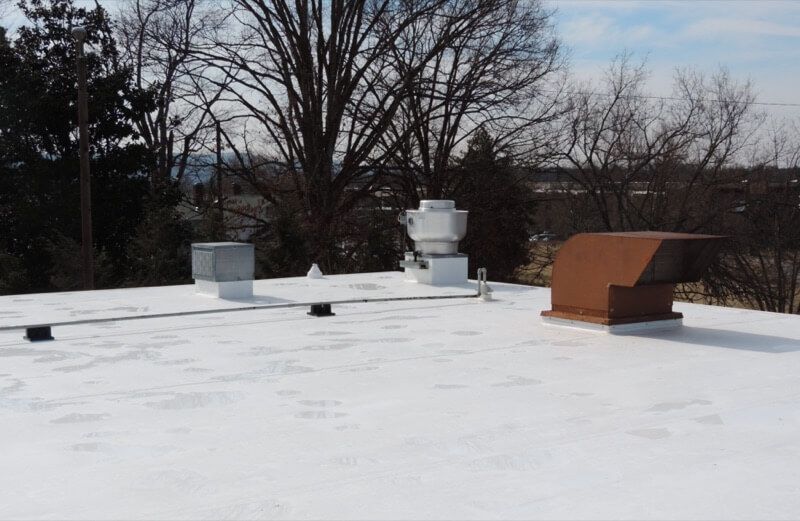
Reflective white single-ply membranes (such as TPO or PVC) maintain an initial Solar Reflectance Index (SRI) exceeding 100. By reflecting up to 85% of solar energy away from the building envelope, white "cool roofs" lower surface temperatures by up to 60°F compared to dark asphalt surfaces.
This substantial temperature reduction offers direct operational advantages for auto dealers:
- HVAC Compressor Relief: Prevents rooftop cooling units from overworking during peak summer heatwaves.
- Showroom Comfort: Reduces radiant heat transferring through the ceiling deck, keeping sales floors comfortable for clients.
- Energy Cost Reductions: Lowers monthly utility overhead across expansive retail footprints.
Facility directors interested in long-term sustainability can learn more by reading our guide on the benefits of installing a cool roof.
Managing Roof Replacement on Active, Occupied Dealerships
Replacing a roof on an active auto dealership requires meticulous staging, strict safety protocols, and clear coordination with dealership management.
Protecting Vehicle Inventory and Customer Areas
- Fenced Staging Zones: Material staging, crane operations, and tear-off dumpsters must be completely enclosed within locked security fencing away from customer parking and new car inventory lots.
- Debris and Dust Containment: Tear-off operations over showrooms or offices must utilize sealed trash chutes and negative-pressure dust walls inside the building to prevent falling dust from damaging vehicle finishes or interior displays.
- Vapor and Fume Control: Using solvent-free, low-VOC adhesives or self-adhered membranes prevents chemical odors from entering rooftop HVAC intakes and bothering customers or service advisors.
Reroofing Strategies: Overlay vs. Complete Tear-Off
When a dealership roof reaches the end of its useful lifespan, owners must evaluate whether to perform a complete tear-off or install a single-layer recover overlay. While overlays offer lower upfront costs and faster installation, wet or saturated insulation must always be replaced to preserve structural integrity. Dealership leaders can weigh the options by reading our article on roof overlay vs. complete tear-off options.
Preventative Maintenance Protocols for Auto Dealerships
Because dealership roofs house numerous rooftop HVAC units, exhaust fans, air compressors, and skylights, routine preventative maintenance is essential to prevent costly emergency leaks.
Semi-Annual Dealership Inspection Checklist
- Clear Internal Drains and Scuppers: Remove leaves, dust, and wash-bay residue from drain sumps to prevent ponding water.
- Inspect Service Bay Exhaust Zones: Check PVC or KEE membranes around exhaust vents for oil buildup, grease-trap overflow, or seam fatigue.
- Audit Skylight Sealants: Examine perimeter counter-flashings, expansion joints, and skylight dome seals for cracking or UV deterioration.
- Walkway Pad Placement: Verify that heavy-duty PVC or TPO walkway pads are installed along all primary maintenance paths between rooftop mechanical equipment.
Dealership operators can safeguard their facilities and preserve manufacturer warranties by establishing a schedule through a commercial roof maintenance plan.
Dealerships located in the Greater Knoxville region can consult regional specialists offering commercial roofing in Knoxville, TN to design custom maintenance programs or schedule structural roof evaluations.
Decision Matrix: Specifying the Ideal Dealership Roof
Use this decision matrix to align each zone of your auto dealership facility with the optimal roofing assembly:
Partnering with Certified Commercial Roofing Experts
An auto dealership represents a substantial real estate investment and a high-value operational engine. Protecting vehicle inventory, service productivity, and the client retail experience requires an engineered commercial roof assembly backed by precise installation practices.
By matching the right membrane chemistry to each facility zone—deploying chemical-grade PVC over service bays, white reflective single-ply over showrooms, and robust skylight flashings throughout—dealership owners ensure long-term durability and peace of mind.
If your auto dealership, service center, or commercial retail facility requires a structural roof evaluation, skylight audit, or replacement proposal, contact RC Roofing, LLC today to schedule a consultation and get a commercial roofing quote!